Where the numbers
come from.
Every tech pack is full of measurements. A chest, a sleeve, a rise, a hem sweep. The obvious worry with anything built on AI is simple: did a machine just make those up? Here is the honest answer, and it is the whole reason Seamix works.
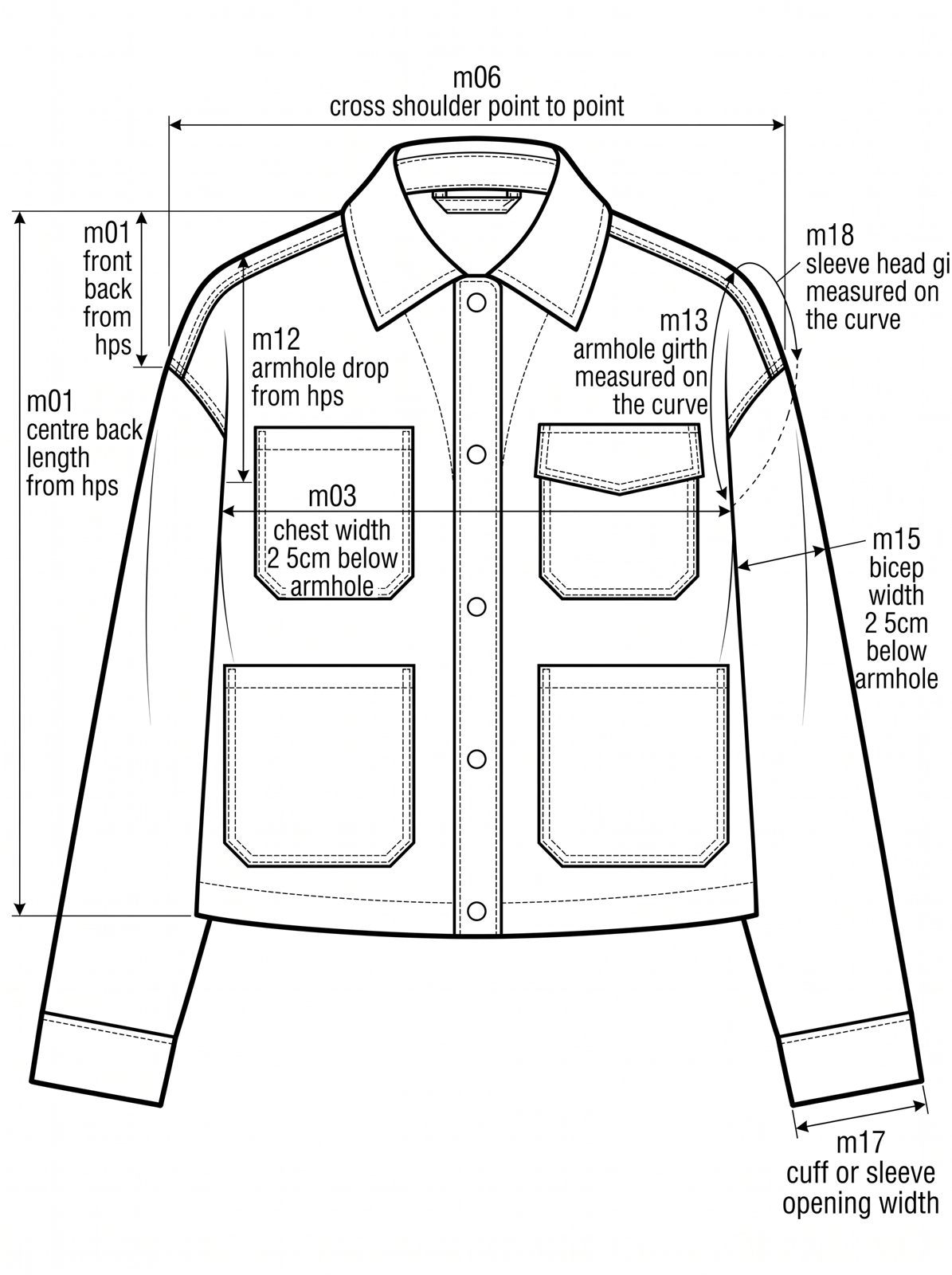
The AI never picks a measurement.
It reads your sentence and works out what you meant — oversized, mid-calf, dropped shoulder, cropped. Then it hands that over, and ordinary arithmetic written by hand does the rest. Two different jobs, done by two different things, and only one of them is a language model.
What you meant
- Which garment this is — a chore jacket, not a blazer
- The shape words: oversized, boxy, tapered, cropped
- The construction words: raglan sleeve, camp collar, unlined
- The fabric, the trims, the colourways
- Which words you used that it must not quietly change
Every single number
- The base body it drafts from, in centimetres
- How much ease each shape word adds, and where
- Every point of measure on the chart
- How each one grows and shrinks across the size run
- The tolerance a factory is allowed to work inside
“Arithmetic is not a language task.”— comment at the top of the measurement engine
25 things a garment is not allowed to be.
Getting the arithmetic right is not the same as getting the garment right. So once the chart exists, a rulebook runs over it — the kind of thing an experienced pattern cutter would spot in a second, written down so it is checked every time. 21 of these can stop a pack. 4 leave a note.
| Refuses | If broken |
|---|---|
| The chest must clear the body it is drafted for, and cannot exceed it by more than any garment carries.CHEST_FITS_THE_BODY | Pack blocked |
| The heel cannot sit lower than the forefoot it is drafted with.SHOE_DROP_IS_POSITIVE | Pack blocked |
| A shaft must be wider round than the foot that passes through it.BOOT_SHAFT_CLEARS_FOOT | Pack blocked |
| Dart intake cannot exceed the waist to hip difference it shapes.DART_INTAKE_FITS_SUPPRESSION | Pack blocked |
| The measured length must be the length the style claims to be.SKIRT_LENGTH_MATCHES_CLASS | Pack blocked |
| Stated volume must reconcile with height by width by gusset.BAG_VOLUME_RECONCILES | Pack blocked |
| A main opening cannot be longer than the panel it is cut into.BAG_OPENING_FITS_WIDTH | Pack blocked |
| The shortest strap setting cannot be longer than the longest.BAG_STRAP_RANGE_ORDERED | Pack blocked |
| A pocket must sit high enough that the pocket itself clears the front hem.POCKET_FITS_ABOVE_HEM | Pack blocked |
| Sleeve head girth must be able to fill the armhole girth (ease 4-12%).SLEEVE_FITS_ARMHOLE | Pack blocked |
| Below-knee lengths need sweep >= stride minimum or a vent/slit.HEM_SWEEP_CLEARS_STRIDE | Pack blocked |
| Cross shoulder must sit within a sane ratio of half chest for the silhouette.SHOULDER_TO_CHEST_RATIO | Note on the pack |
| CF/CB length difference must match the stated hem shape.FRONT_BACK_LENGTH_DIFFERENTIAL | Note on the pack |
| Front rise, back rise and inseam must reconcile with outseam length.RISE_VS_INSEAM | Pack blocked |
| Waist must be smaller than hip unless silhouette is boxy/straight.WAIST_HIP_PROGRESSION | Note on the pack |
| On a one piece the bodice hem, the waist and the leg top are one seam and must measure the same.JOIN_SEAM_CLOSES | Pack blocked |
| A leg described as wide or tapered must measure that way at the knee and the opening.LEG_WIDTH_PROGRESSION | Pack blocked |
| Non-opening necklines need a head circumference pass or stretch allowance.PULLOVER_HEAD_OPENING | Pack blocked |
| Non-opening cuffs must clear hand girth or need a placket.CUFF_CLEARS_HAND | Pack blocked |
| Unlined garments cannot carry canvas, chest pieces or pad stitching.STRUCTURE_MATCHES_INTERLINING | Pack blocked |
| Waterproof claims require seam seal tape in the BOM and a taped finish.SEALED_SEAM_REQUIRES_TAPE | Pack blocked |
| Knit fabrics require stretch stitch classes on load-bearing seams.KNIT_STITCH_COMPATIBILITY | Pack blocked |
| A shaft standing above the ankle needs a closure that opens or an elastic gusset.SHOE_ENTRY_CLEARS_FOOT | Pack blocked |
| A knee length declaration has to be carried by a shaft the chart actually measures.SHAFT_MATCHES_LENGTH_CLASS | Pack blocked |
| Stitch density must be inside the range the fabric weight can carry.GSM_VS_SPI | Note on the pack |
Bring your measurements. It checks them first.
You can draft on a standard body, or hand Seamix your brand’s own. 18 measurements, each with a range it has to sit inside — because one mistyped number quietly ruins a whole pack, and a pack with your brand’s name on it being wrong is worse than a pack that is merely standard. Try it: change a number, or load one of the examples.
- Nothing to report.
The pictures get checked too.
Numbers are the easy half. A drawing can come back looking like a garment and still be useless — a front view painted in as a solid shape, or a side view that is quietly a second copy of the front. So nothing is trusted just because it was asked for nicely.
The drawing is measured, not admired
Before anything looks at whether a drawing is correct, arithmetic checks whether it is a technical drawing at all. How much ink is on the sheet, how much of the frame one flat colour covers. A front elevation that came back as a solid painted shape fails on the numbers, goes back, and is drawn again.
Closed questions, not “is this good?”
Then each drawing is inspected against the specification it came from, one yes-or-no question at a time. Are there buttons visible on the front face? Asking a model whether its own work is good is close to worthless. Asking it something answerable is not.
A missing page is never papered over
If a required view genuinely cannot be produced, the pack does not print a placeholder and stay quiet. It is marked incomplete on its face and cannot be exported. A tech pack with a hole in it is not a tech pack.
Badges are earned, not printed
Every claim on a finished pack is computed from what actually happened during the run — how many measurements were calculated, on which engine, from whose body, how many rules were checked, how many blocked. Nothing is stamped on because it looks reassuring.
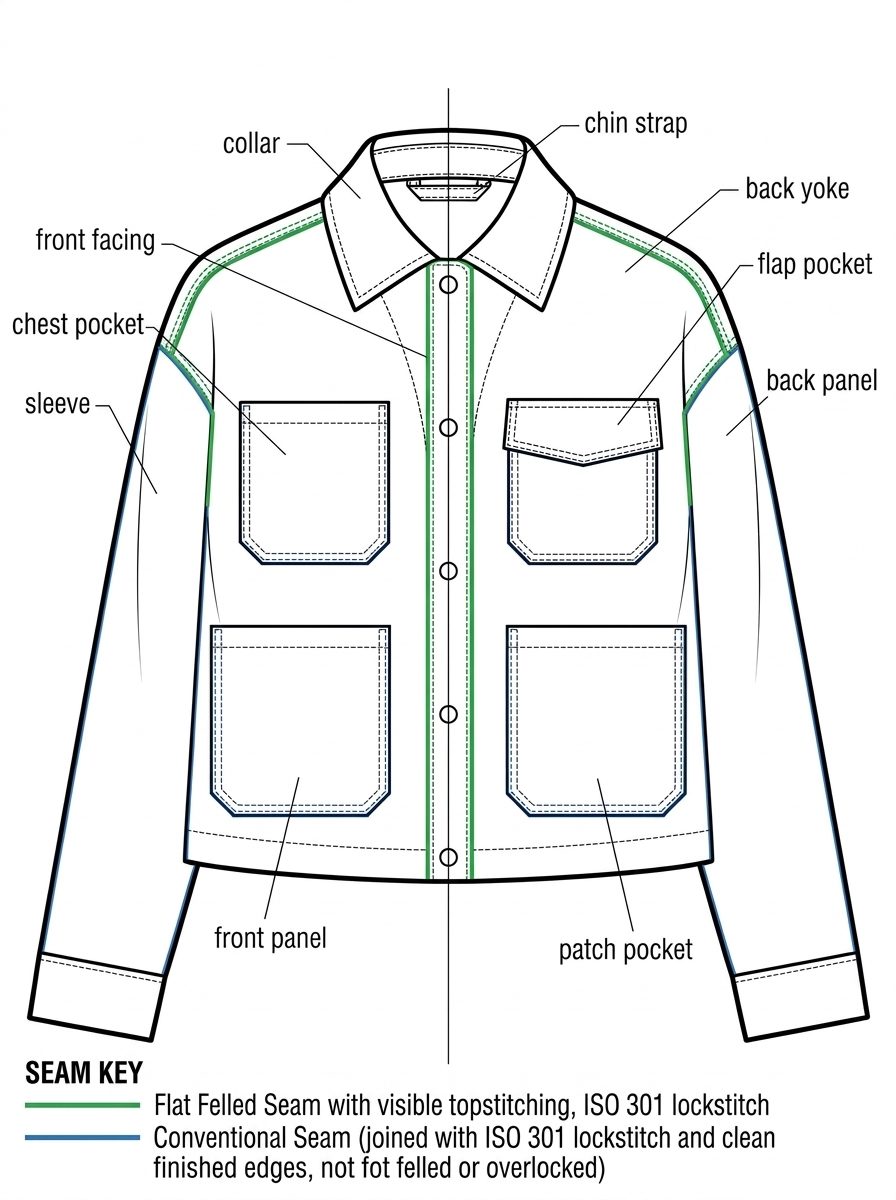
Line work, not a picture of a jacket
A correct technical drawing looks like this: unfilled white ground, line weight used as grammar — heavier for an outline, lighter for a seam, dashed for what sits behind — and a key naming what each line means.
The ink check is arithmetic against exactly that. A sheet with almost no ink on it has not been drawn. A sheet where one flat colour covers a quarter of the frame is a painted shape, not line work. Both go back and get drawn again.
Nothing blocking, nothing to note.
Export unlockedNothing blocking. Some advisories worth a read first.
Export unlockedAt least one blocking problem, listed in full so you can fix the brief and run it again.
Export heldA required view could not be produced. This one is not finished — do not send it anywhere.
Export heldEvery rule is tested without spending a penny.
A rule that can only be checked by paying for a live run is a rule nobody dares improve — and a rule nobody dares improve is where the next mistake hides. So the entire deterministic half of Seamix — the specification, the measurement engine, the rulebook, the inspector’s logic — replays against real cases from real packs. No model is called. No credit is spent. It finishes in milliseconds, and every fixed defect stays fixed.
Alongside it, a second instrument builds 400 legal garment specifications straight out of the catalogue and compiles all 4,800 view instructions, checking that what a drawing is told to do is the same thing the inspector will look for.
What none of this proves.
Any accuracy page that only lists strengths is selling you something. These are the real edges, and knowing them is what lets you use Seamix properly.
A pack is a draft, not a finished spec
Everything here proves a pack agrees with itself and obeys the rules of garment construction. None of it proves the garment is good, that the block suits your fabric, or that a factory can hit your price. A technologist should read it. Fit still has to be confirmed on a real sample against your own blocks.
The rulebook prevents as much as it catches
Several rules exist to stop a chart contradicting itself after somebody edits a measurement by hand. They are guardrails around your corrections, not evidence that the engine was producing broken garments before they were written.
Not every category is equally mature
Tops, outerwear, trousers, skirts and dresses carry the deepest rulebooks. Footwear carries fewer, and bags fewer still — several of those are recent. Treat a bag pack as a stronger starting point than a finished one.
The self-test covers the maths, not the beauty
Those 1,127 checks call no model. They prove the arithmetic and the rules hold still. They cannot prove a drawing came back beautiful — that is what the ink check, the inspector and, finally, your own eyes are for.
See the numbers on your own design.
Your first tech pack is free, and every page of it shows its working. No card, no drawing skills.