You stay the designer.
The worst thing a tool like this can do is quietly decide something on your behalf and never tell you. So Seamix does the opposite: before a single line is drawn, it shows you everything it understood, as lists you can change, and it holds itself to the words you actually typed.
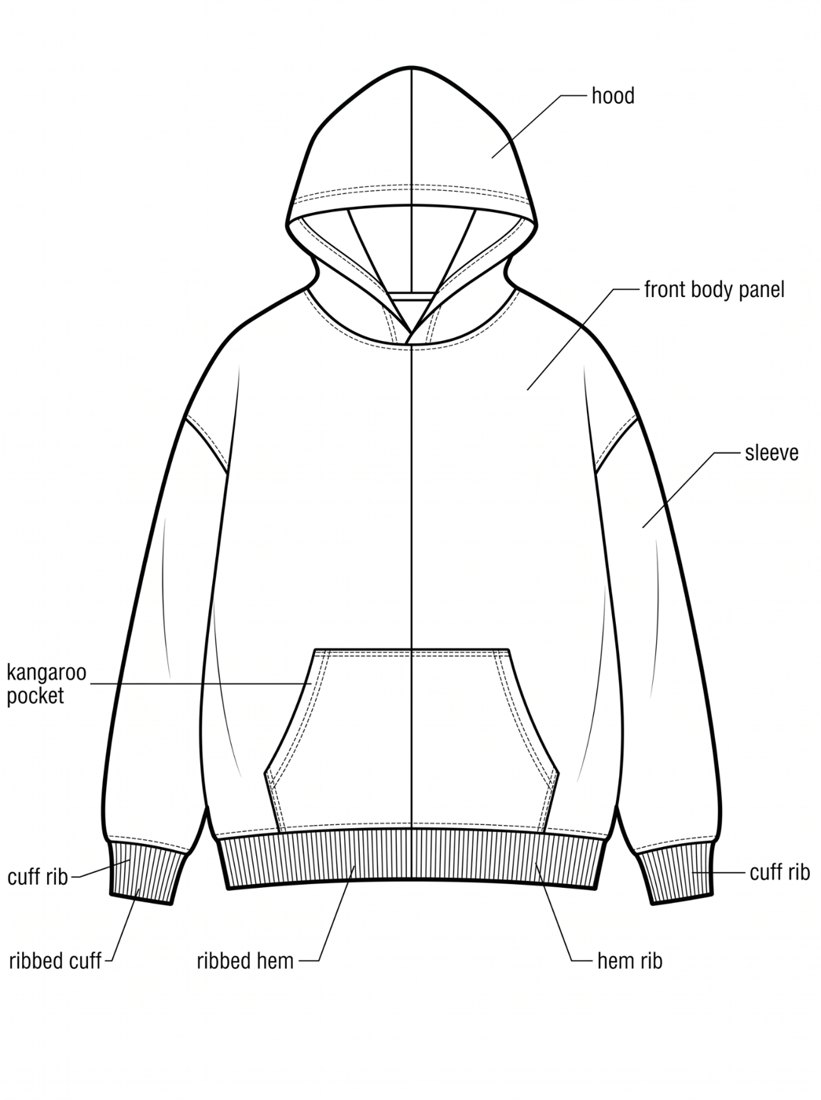
Say it the way you’d say it to a friend.
No form with forty dropdowns. No jargon you have to learn first. Write what you want to make in ordinary sentences — the fabric, the fit, the pockets, the details you care about — and attach a photo if a picture says it faster.
The Studio, as it actually looks
3 photographs per run, on every plan including the free one. They are prompting context and nothing else — never written to your project, your version history or an export. They exist in the tab you are working in until the run finishes, and nowhere else.
Everything it understood, before anything is drawn.
14 decisions turn your sentences into a garment, and you see all 14. Each one is a closed list of what your pattern block actually permits — so you cannot pick something impossible, and Seamix cannot hold a choice you never made. This is CJ‑001, the chore jacket, exactly as it came back. Change anything you like.
A brief once said “two button front closure” for a blazer. The catalogue had no word for a single-breasted front at the time, so the engine picked the nearest legal value it did have — and five separate problems followed from that one substitution.
The real failure was not the wrong word. It was that the only place that word ever appeared was inside a prompt. Nobody could have caught it, because nobody could see it. This screen is the fix: every decision the engine is holding is on the outside of the machine, in front of you, before it costs you anything.
It holds itself to what you typed.
If you name a fabric weight, a seam finish or where the closure sits, that is not a hint — it is an instruction. Seamix re-reads your brief against the finished specification and blocks the pack if the two have drifted apart. A number you typed yourself is the one number nobody should be allowed to quietly round.
Say your brief reads as “no vents” but you decide on the confirm screen that you do want one. Seamix lifts that restriction — and records on the pack that you lifted it, with the reason. Your override is documented, never silent, so six weeks later nobody is wondering why the jacket has a vent the brief said it wouldn’t.
Measure a shirt you love. Use it forever.
Fit is what makes a brand recognisable, and a standard body will never be yours. Give Seamix your block once — by typing it in, or by measuring a garment you already own laid flat — and it goes under every pack you make on that block from then on.
Measure something real
Lay a shirt that fits the way you want on a table and measure it flat. Seamix works backwards from the garment to the body underneath it. No tape measure around a person, no pattern-cutting knowledge, no guesswork about ease.
Type your block in
If you already have a block you work to, enter it directly. Eighteen measurements, each checked against a sensible range, so one mistyped number cannot quietly ruin every pack you make afterwards.
Overrides a decision you made on purpose
A saved fit is a default, not an override. If the pack in front of you already carries a body — typed in, measured on this pack, or inherited from a pack you reopened — it keeps it. Seamix does not quietly replace something you did deliberately.
Carries a length across garments
You saved the fit of a shirt. That shirt’s length has nothing useful to say about the coat you are drafting now, so the body carries over and the length does not. You chose this pack’s length on purpose.
Puts a men’s body under a women’s block
One fit per fit block — men’s, women’s, unisex, kids. A brand making both keeps two, and there is no lookup that could ever fetch the wrong one. Every uncertain case answers no, and you apply a fit by hand instead.
A pack drafted on the standard body says so on its face and is simply less tailored. A pack drafted on the wrong body carries your brand’s name and is wrong. That is the whole reason every doubtful case refuses.
Change your mind in words, not in Illustrator.
This is where the twenty minutes really pays. Want the pocket bigger, the fabric heavier, the whole thing in three more colours? Edit the sentence and run it again. Nothing is redrawn by hand, and you only pay for the part that actually changes.
Redraw one view
You like the pack but not the back elevation. Redraw that one drawing and leave the others alone.
Extend the size run
Your chart runs S to XL and the buyer wants XXL. The grade rules already exist, so it is arithmetic, not a new pack.
Rewrite the spec
Change the brief and regenerate the written specification against it, keeping the drawings you already have.
A new colourway
The same jacket in three more colours. It reuses the specification you already approved, so it costs half a pack.
A full pack is 10 credits, and your free trial is exactly 10 — one complete pack, nothing held back, no card. Viewing, editing by hand, share links, version history and every download are free and always have been.
Type one sentence and see what it says back.
Your first pack is free. You will see every decision it makes before it makes them.